


The Ho Chi Minh City area and neighboring provinces such as Binh Duong and Dong Nai have a humid tropical climate with heavy rainfall and high humidity year-round – the ideal environment for water infiltration to rapidly cause yellow-stained walls across most residential and industrial buildings.
If you are frustrated by the ugly yellow stains appearing on your house walls, exterior walls or interior walls after every rainy season, do not rush to repaint without treating the root cause. This article will help you understand the causes, consequences and how to permanently treat yellow-stained walls with professional Acrylic technology from Euro Paint Vietnam.
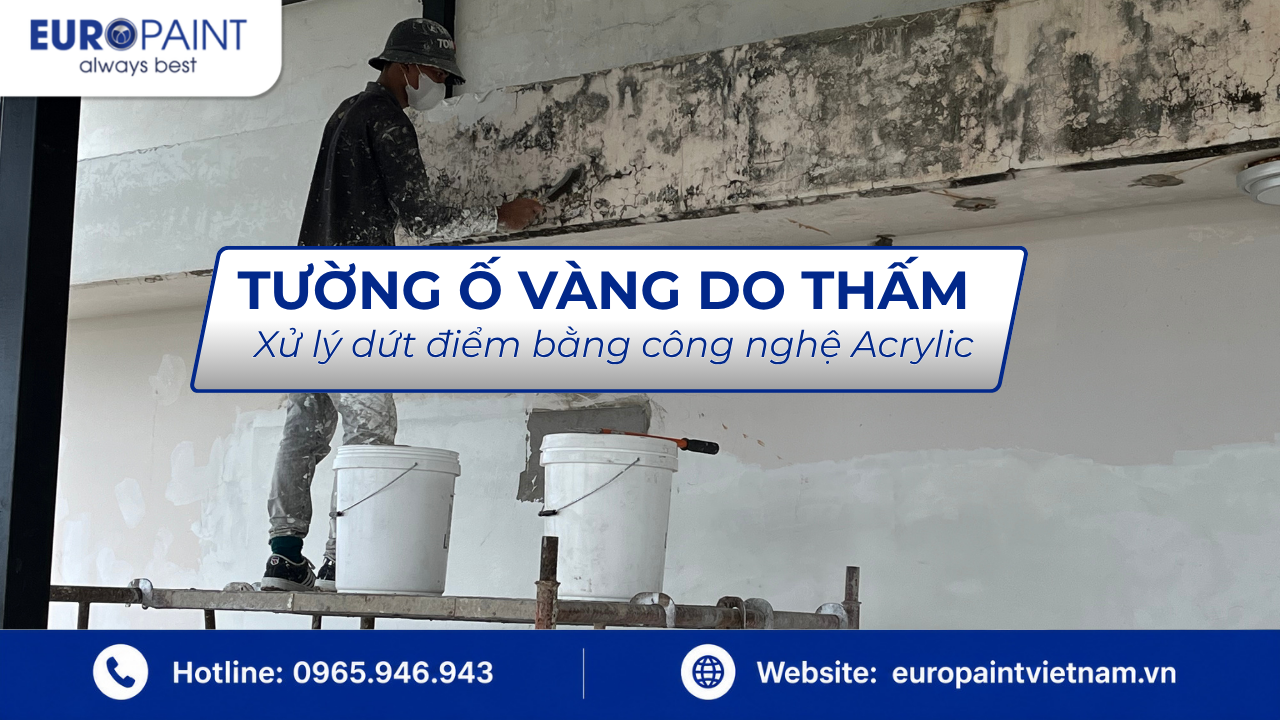
What Are Yellow-Stained Walls? Why Do They Appear?
Yellow-stained walls is the condition in which the wall surface develops blotches of yellow, light brown or orange staining that usually spread over time if not treated promptly. This is not merely an aesthetic problem but a clear warning sign that the wall structure is being eroded by moisture and water infiltrating from the outside or inside.
Essentially, when water penetrates the render or concrete, it dissolves mineral salts, iron ions and organic compounds in the building material and draws them to the surface. As the water evaporates, these substances are left behind, forming the characteristic yellow or brown stains. In addition, prolonged high humidity creates conditions for moss and mold to grow, making yellow-stained walls progressively worse.
The Main Causes of Yellow-Stained Walls
- Infiltration from the roof or floor above: Rainwater penetrates the concrete roof, terrace or balcony and flows down the wall along the structure, causing yellow stains running from top to bottom.
- Lateral infiltration from exterior walls: Walls exposed directly to rain without a waterproofing layer, or with a damaged one, let water soak into the wall core and cause staining from the inside out.
- Moisture condensation: In areas with a large temperature difference between inside and outside, moisture condenses on the wall surface and, accumulating over time, causes yellow staining.
- Hairline or structural cracks: Even small cracks are pathways for water into the wall, especially dangerous on outdoor walls.
- Poor-quality building materials: Render with a substandard cement ratio and aggregates full of organic impurities oxidize easily and cause staining when exposed to moisture.
- Blocked drainage systems: Clogged gutters and drainpipes cause water to pool and overflow into the wall.
Learn more about the signs and treatment of water-infiltrated walls from various causes for a more comprehensive approach.
Serious Consequences of Leaving Yellow-Stained Walls Untreated
Many homeowners and building owners underestimate yellow-stained walls, simply repainting the surface to cover the stains without treating the root cause. This is a serious mistake that leads to increasingly costly consequences:
- Destruction of the concrete structure and reinforcement: Prolonged water infiltration corrodes the internal steel reinforcement, cracks the concrete and significantly shortens the building’s service life.
- Growth of harmful mold: A damp environment is ideal for mold, directly affecting occupants’ health, especially children and the elderly.
- Continuous paint peeling: No matter how many times you repaint, if the infiltration is not treated the new paint will keep blistering and peeling within a few months.
- Loss of aesthetic and property value: A building with blotchy yellow-stained walls loses real-estate value and harms the brand image of factories and offices.
- Escalating repair costs: The longer it is left, the wider the damage spreads and the higher the cost of thorough treatment – many times more than treating it early.
If your walls already show cracks along with yellow staining, refer immediately to the wall-crack treatment guide to stop water infiltration from the earliest stage.
Treating Yellow-Stained Walls with Euro Polymers Acrylic Technology
Euro Paint Vietnam provides a water-based Acrylic waterproofing system specifically for walls, designed to permanently treat the cause of yellow-stained walls from within the structure. The system consists of 3 perfectly coordinated layers, each performing a distinct, mutually reinforcing function.
The 3-Layer Euro Polymers AC System – A Complete Solution for Yellow-Stained Walls
| Product | Type | Main function | Application | Color |
|---|---|---|---|---|
| Euro Polymers AC-100 Primer | Water-based, single-component Acrylic primer | Penetrates deep into the substrate, boosts adhesion, seals the surface, prevents mineral salts and impurities from migrating back out and causing staining | Mandatory base coat before AC-250 and AC-300 | Transparent |
| Euro Polymers AC-250 | Water-based, single-component Acrylic waterproofing with extremely high elasticity | Forms an extremely elastic membrane, bridges hairline cracks, blocks water infiltration through the wall and prevents recurrence of staining | Intermediate crack-resistant layer for walls | Many colors |
| Euro Polymers AC-300 | Water-based, single-component, high-elasticity Acrylic waterproofing | Color-fast finishing layer that waterproofs, resists UV and protects the wall from long-term weathering | Outermost finishing layer for walls | Rich range of colors |
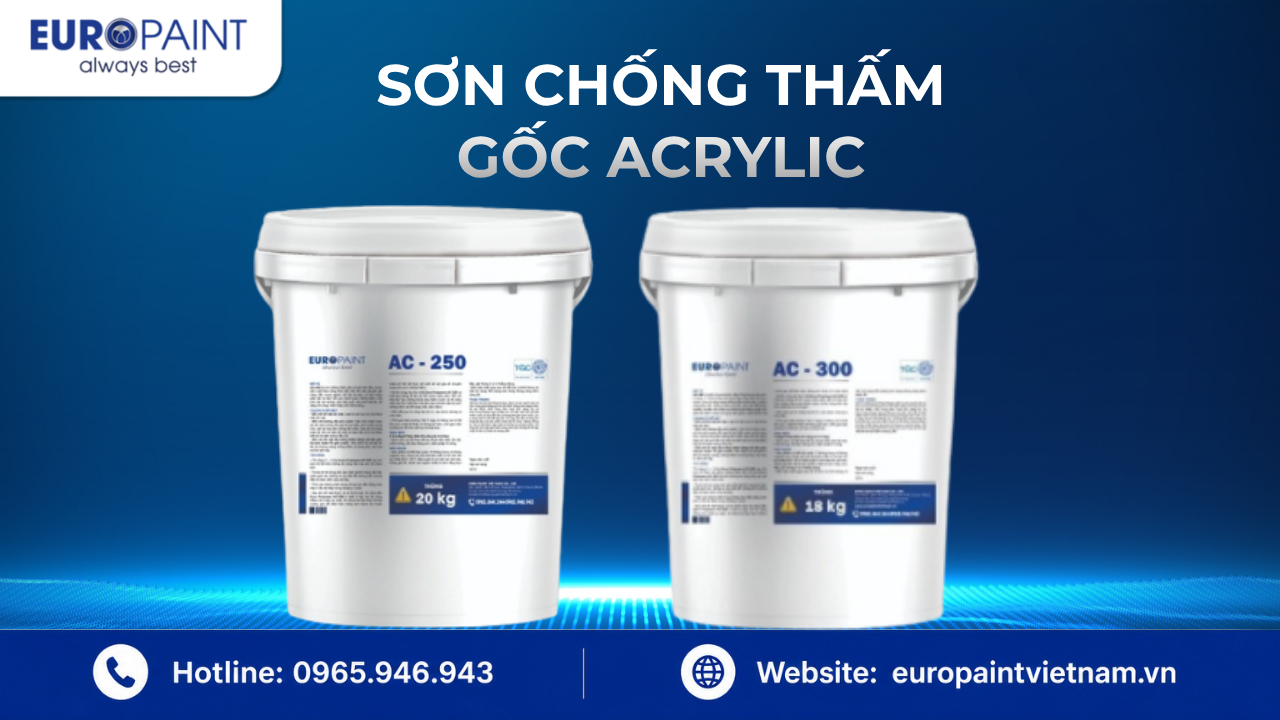
The Outstanding Advantages of Euro Polymers Water-Based Acrylic Technology
- Extremely high elasticity with AC-250: Its outstanding stretch lets the waterproofing membrane self-bridge newly formed hairline cracks without tearing, preventing water from infiltrating the wall and causing staining to recur.
- Water-based – safe and environmentally friendly: Contains no toxic solvents, suitable for application in enclosed spaces and safe for users and the surrounding environment.
- Excellent adhesion: The AC-100 Primer penetrates deep into the concrete or render substrate, forming a strong mechanical bond that ensures the whole system does not peel over time.
- UV resistance and color retention: AC-300 has good UV resistance, keeping colors bright without yellowing or fading under direct sunlight.
- Multi-color: Both AC-250 and AC-300 come in many color options, perfectly combining waterproofing function with building aesthetics.
- Simple application: A single-component system with no complex mixing, applicable by brush, roller or spray, suitable for projects of many scales.
Learn more about the Euro Polymers Acrylic waterproofing paint line – specifications, coverage rates and standard application guidance for walls.
The Correct Technical Process for Treating Yellow-Stained Walls
To treat yellow-stained walls thoroughly and ensure long-term effectiveness, following the correct application process is key. Euro Paint Vietnam’s technical team, with over 20 years’ experience, recommends the following 6-step process:
- Step 1 – Survey and assessment: Determine the extent and degree of infiltration, the source of the yellow-stained walls, and measure surface moisture to choose the right solution.
- Step 2 – Surface preparation: Chip off all peeling old paint and hollow render, and thoroughly clean moss and mold with a specialized fungicide. This is the most important step, determining the adhesion of the waterproofing system.
- Step 3 – Treat cracks and local infiltration points: Inject Epoxy D-200 into dry cracks and level them with specialized repair mortar before applying the waterproofing layer.
- Step 4 – Apply AC-100 Primer: Roll or brush 1–2 even coats of AC-100 Primer over the entire wall surface and allow to dry completely (about 2–4 hours depending on weather).
- Step 5 – Apply AC-250 (crack-resistant layer): Apply 2 coats of AC-250 in perpendicular directions to ensure even coverage and optimal crack-bridging. Allow to dry between coats.
- Step 6 – Apply AC-300 (finishing layer): Apply 1–2 coats of AC-300 as a color-fast, UV-resistant finishing layer that protects the whole system and gives the building a high-quality appearance.
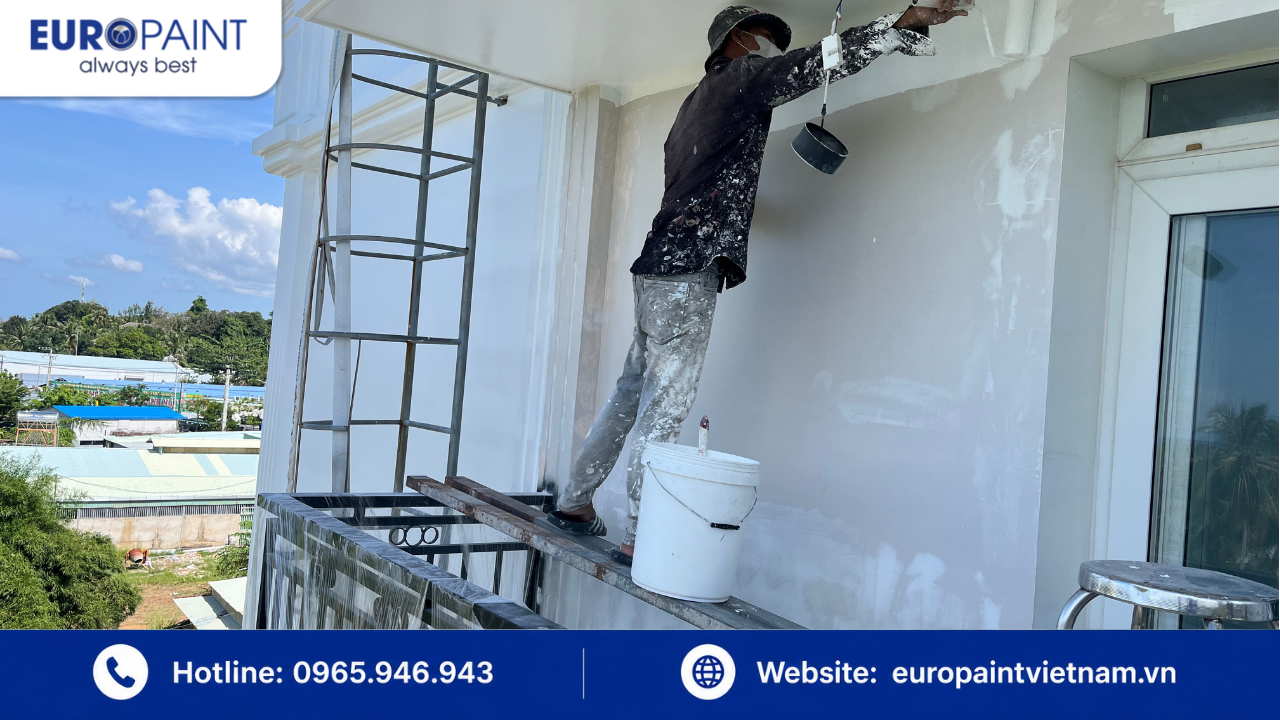
See the detailed standard waterproofing application process to Euro Paint Vietnam’s technical standards to ensure lasting results for your project.
Comparing Common Methods for Treating Yellow-Stained Walls
There are many methods on the market for treating yellow-stained walls, but not all deliver lasting results. The comparison table below gives you an overview and helps you choose wisely:
| Method | Advantages | Disadvantages | Service life | Suitability |
|---|---|---|---|---|
| Ordinary repainting (covering the stain) | Low cost, quick to apply | Does not treat the cause, recurs after 3–6 months | 3 – 6 months | ❌ Not recommended |
| Acrylic waterproofing (Euro Polymers AC-250/AC-300) | High elasticity, color-fast, safe water base, good UV resistance | Requires careful surface preparation, not for load-bearing floors | 5 – 10 years | ✅ Very suitable for walls |
| Polyurethane waterproofing (UP-255/UP-155) | High elasticity, mechanically durable, good load-bearing | Solvent-based, needs ventilation during application, higher cost | 8 – 15 years | ✅ Suitable for floors, roofs, heavy exposed walls |
| Cementitious waterproofing mortar | Hard and strong, good water-pressure resistance | Inelastic, cracks with the structure, no UV resistance | 3 – 5 years | ⚠️ Suitable for water tanks, not for exterior walls |
Clearly, for treating yellow-stained walls caused by water infiltration on exterior and interior walls, the Euro Polymers AC-250 and AC-300 water-based Acrylic waterproofing system is the optimal choice in terms of both technical effectiveness and long-term investment cost.
Want to understand the difference between material types? Read our Acrylic vs Polyurethane comparison to choose the right solution for each location.
Important Notes When Treating Yellow-Stained Walls
To ensure lasting, recurrence-free treatment of yellow-stained walls, there are several important technical notes that both investors and applicators should understand:
- Do not apply in rain or at very high humidity: The wall surface must reach a moisture level below 8% before applying the AC-100 primer to ensure maximum adhesion.
- Do not skip the AC-100 Primer: This is the layer that seals the surface and prevents mineral salts from migrating back out – skipping it will cause yellow-stained walls to recur even after applying the waterproofing layer.
- Treat the source of infiltration thoroughly first: If the cause is a leaking roof or floor above, waterproof the roof first, then treat the wall, to avoid wasted effort.
- Allow enough drying time between coats: Do not apply the next coat before the previous one is completely dry, to avoid air bubbles and reduced adhesion.
- Inspect and maintain periodically: Even though the Euro Polymers Acrylic system has a long service life, an inspection every 2–3 years helps detect and treat local damage early before it spreads.
If your building has infiltrated outdoor walls together with yellow-stained walls, also refer to the outdoor-wall waterproofing solution for the most comprehensive approach.
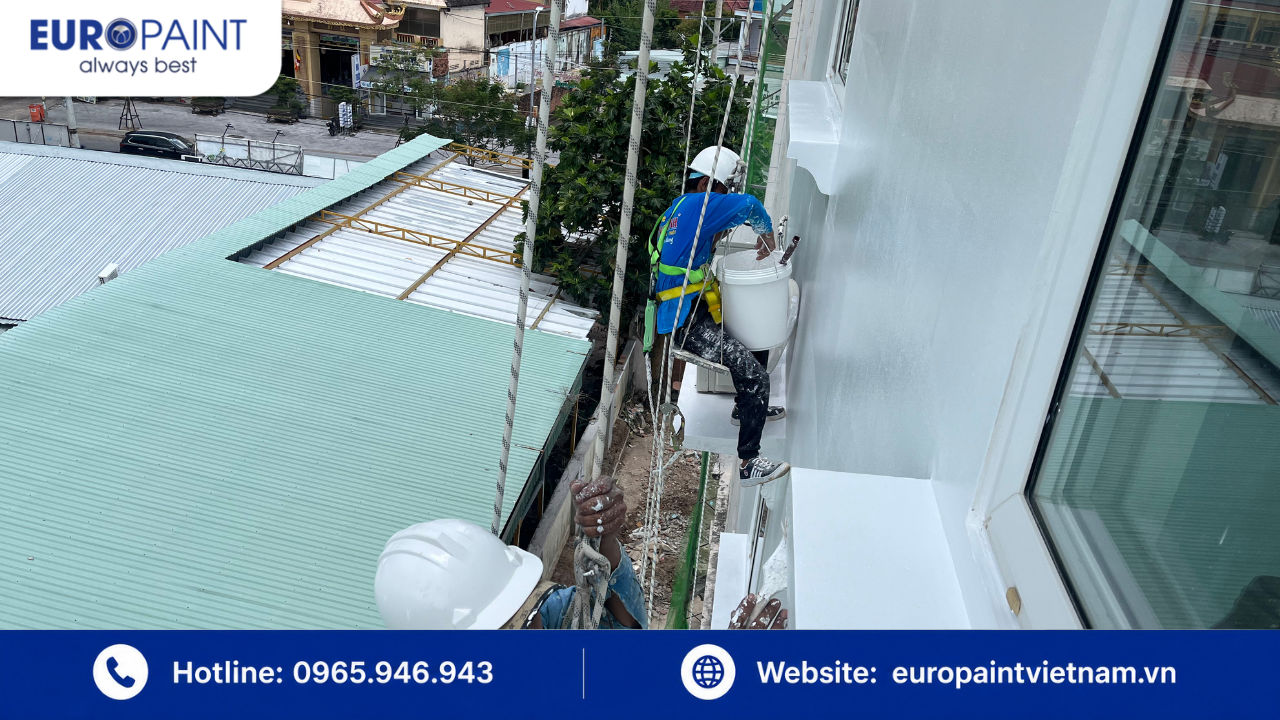
Conclusion
Yellow-stained walls are not merely an aesthetic issue but a direct consequence of prolonged water infiltration within the wall structure. If not treated correctly and promptly, yellow-stained walls lead to serious structural damage, harmful mold and ever-increasing repair costs.
The Euro Polymers water-based Acrylic waterproofing system – comprising AC-100 Primer, AC-250 and AC-300 – is a comprehensive solution specifically designed to treat the cause of yellow-stained walls at the root. With its extremely high elasticity, excellent adhesion, durable UV resistance and fully water-based safety, it is the top choice trusted by professional contractors and investors.
Euro Paint Vietnam not only supplies high-quality materials but also accompanies applicators throughout the process – from survey and solution selection to application and post-project warranty – true to its philosophy of “Pioneering Solutions – Superior Quality”.
Also refer to the comprehensive house-wall waterproofing solutions from Euro Paint Vietnam to protect your building for the long term.
Contact Euro Paint Vietnam – Get Free Consulting & Sample Testing
Are you dealing with yellow-stained walls and unsure where to start? Euro Paint Vietnam’s professional engineering team is ready to help with surveys, solution consulting and completely free test samples.
- 🏢 Address: 64/27 KP Binh Phuoc B, An Phu Ward, Ho Chi Minh City
- 📞 Hotline / Zalo: 0965.946.943
- 📧 Email: info@europaintvietnam.vn
- 🌐 Website: europaintvietnam.vn
- 💬 Zalo: Chat on Zalo for pricing & product technical documents
Fill in the form on the website to receive a full quote & catalogue within 24 hours. 24/7 technical support – a commitment to quality and complete satisfaction from Euro Paint Vietnam.